
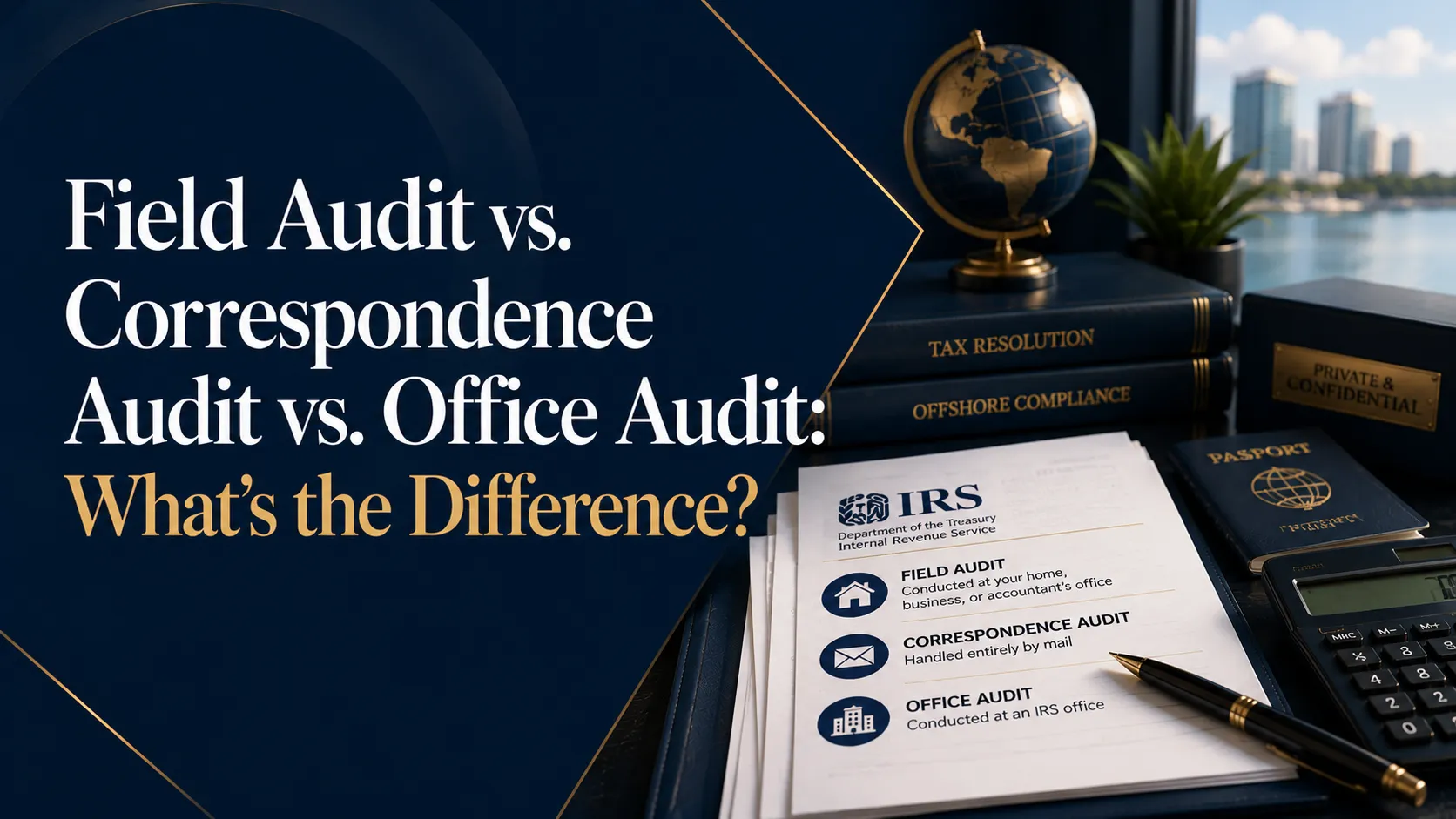
The IRS runs three types of audits: correspondence, office, and field. A correspondence audit happens entirely by mail and targets one or two line items. An office audit brings you into a local IRS office to discuss a handful of issues. A field audit sends a revenue agent to your home or business for a full review of your books.
This article breaks down all three audit types using IRS Publication 556, Publication 3498, and Publication 3498-A, shows you how to identify your audit type from the letter itself, and explains what happens after the IRS reaches a decision.
Key Takeaways
|
What Are the Different Types of IRS Audits?
The IRS examines returns by mail or in person, and in-person exams split further into office audits and field audits. Correspondence exams involve a few straightforward issues resolved through paperwork, office audits cover moderately complex items reviewed face-to-face at an IRS office, and field audits handle the most complex cases through a full review at your location. Many examinations end in a refund or in the return being accepted exactly as filed.
How the IRS Selects a Return for Audit
The IRS mainly uses a computer scoring system called the Discriminant Function System (DIF), which assigns a numeric score to returns based on the likelihood that a change to tax liability will result. Returns are also flagged when income reported by employers or banks on Forms W-2 and 1099 does not match what you reported, a mismatch that generates an automated notice.
Common IRS audit triggers include unreported 1099 or W-2 income, disproportionately large deductions relative to income, and related examinations, where auditing a partnership or S corporation pulls in the individual partners’ returns too.
The chances of an IRS audit for an individual return remain low in any given year, but they rise sharply with unreported income, cash-heavy businesses, and refundable credit claims like the Employee Retention Credit.
In our practice, we see more taxpayers escalate a simple mismatch into a drawn-out dispute by ignoring the first notice than by anything they did wrong on the original return.

Correspondence Audit: What You Need to Know
A correspondence audit is an IRS examination conducted entirely through the mail, targeting one or two specific items on your return. It is the most common audit format; IRS data shows correspondence exams made up roughly 78% of individual audits in fiscal year 2024.
The IRS mails a letter identifying the item under review, such as a charitable deduction, education credit, or a Schedule C expense, and asks you to mail back supporting documentation.
What Does the IRS Ask You to Provide?
The letter tells you exactly which item is being questioned, what documents to send, and the deadline. You may also receive a correspondence audit letter known as a CP2000, which proposes a tax change because a 1099 or W-2 on file with the IRS does not match your return. A CP2000 is technically an underreporter notice, not a formal audit, but it follows a similar mail-based process.
How to Respond to a Correspondence Audit Letter
- Read the letter fully, compare the IRS’s figures to your own return, and send copies (never originals) of the requested documents by the due date printed on the notice.
- If you need more time, call the number on the letter before the deadline.
- To respond to an IRS audit notice correctly, always keep a dated copy of everything you submit, since the burden of substantiating deductions rests with you.
If you disagree with the proposed changes, do not sign the agreement form. Instead, send a written explanation with your documentation, or request a conference with the examiner’s manager. Missing the deadline lets the IRS issue a Statutory Notice of Deficiency, which starts a fixed 90-day window to petition Tax Court.
Office Audit: What Happens at an IRS Office?
An office audit is an in-person examination held at a local IRS office with a Tax Compliance Officer, covering issues too complex for a mail response but narrower than a full field exam. Typical office audit topics include itemized deductions, home office expenses, or moderate business losses on Schedule C.
Where an Office Audit Takes Place
The exam happens at the IRS office named in your notice, though you can request a different location if it works better for your records. You, your representative, or both attend an initial interview covering your finances and the specific items under review.
Documents You May Need to Bring
The IRS letter lists exactly what to bring: receipts, invoices, bank statements, and any records tied to the flagged item. Organize documents by category and tax year before the appointment; the examiner will request anything missing in writing.
How to Prepare for an Office Audit
- Read the notice completely and note the exact items under review and the appointment date.
- Pull every document connected to those items, not your entire return.
- Reconcile your records against your filed return so the numbers match before you walk in.
- Decide whether to attend alone or bring an attorney, CPA, or enrolled agent under a signed Form 2848.
- Rehearse short, direct answers; the interview covers only what the examiner cannot find elsewhere.
- Request a manager conference in writing if you disagree with the proposed changes.
Field Audit: The Most In-Depth IRS Examination
A field audit is an in-person examination conducted by an IRS revenue agent, typically covering the full scope of a return rather than one or two items. Field exams are reserved for complex returns, larger businesses, and cases where the IRS suspects broader discrepancies.
Where a Field Audit Takes Place
The exam is held at your home, your place of business, or the office of your attorney, accountant, or enrolled agent. Business audits often include a tour of the premises so the agent can understand day-to-day operations.
What the Revenue Agent May Review
A revenue agent typically reviews books and records, related returns such as employment tax filings, prior and subsequent year returns, and bank deposit activity to check for unreported income. The scope can expand mid-exam if the agent identifies new issues.
How the Field Audit Process Works Step by Step
During the IRS field audit process, the IRS mails an initial notice identifying the tax years and issues under review, an opening interview covers your financial history and recordkeeping, the agent tours the business if applicable, documents are reviewed over one or more sessions, and the agent issues a report proposing either no change or specific adjustments.
Correspondence vs. Office vs. Field Audit
The three audit types differ mainly in where they happen, how much of the return is reviewed, and how much documentation is expected. The table below breaks this down side by side.
| Factor | Correspondence Audit | Office Audit | Field Audit |
| Location | By mail | Local IRS office | Home, business, or rep’s office |
| Scope | 1 to 2 items | Several related items | Full return, related entities |
| Documentation | Copies mailed in | Brought to appointment | Reviewed on-site, often over weeks |
| Typical seriousness | Lowest | Moderate | Highest |
Audit Location
Correspondence exams stay entirely within the mail system, office exams require a single visit to an IRS office, and field exams take place where your records actually live: your home or business.
Scope of the Examination
A correspondence audit isolates one or two line items. An office audit covers a limited set of related issues. A field audit can expand to cover multiple tax years and related returns once the agent starts reviewing your records.
Level of Documentation Required
Correspondence audits need copies of specific receipts or statements. Office audits require organized records brought in person. Field audits demand full books and records, often reviewed across several sessions.
How Serious Is Each Audit Type?
Correspondence audits carry the lowest average deficiency because the scope is narrow. Office and field audits involve larger, more complex issues, and field audits carry the highest stakes since the agent has full access to your operations and can expand the exam’s scope.
How to Identify Your Audit Type From the IRS Letter
Every IRS letter or notice includes a code in the upper corner, such as Letter 566 for a general correspondence exam or a specific in-person audit appointment letter. The notice will explicitly state whether the exam is by mail or in person, so read the first page fully before assuming which type you received.
Information the IRS Requests
The letter lists the exact tax year, the specific items in question, and the documents needed. If a letter demands immediate payment by gift card, wire transfer, or threatens arrest, it is not from the IRS. Learning how to spot a fake IRS letter matters: the IRS never initiates contact by email, text, or social media, and always sends written notice by mail before any phone call or visit.
What Documents Should You Prepare for an IRS Audit?
- Gather W-2s, 1099s, K-1s, and any records of cash or self-employment income for the tax year under review.
- Collect receipts, invoices, and mileage logs supporting any deduction or credit the IRS flagged, including home office and charitable contribution documentation.
- Bank and credit card statements help reconcile deposits against reported income, particularly in field audits where the agent may run a full deposit analysis.
- Businesses should have payroll records, Forms 941, general ledgers, and prior-year returns ready, since field exams frequently pull related filings into the review.
How Long Does an IRS Audit Take?
- Correspondence audit timeline: Most correspondence audits resolve within a few months once documentation is submitted, though incomplete responses can extend this significantly.
- Office audit timeline: Office audits typically wrap up in one to a few appointments over a period of weeks, depending on how quickly documentation questions are resolved.
- Field audit timeline: Field audits are the longest, often running several months to over a year, especially for businesses or when the agent expands the scope to additional years.
Can You Have a Professional Represent You During an IRS Audit?
You can represent yourself, but professional IRS audit defense services make sense once the audit covers business records, multiple tax years, or a field exam where the agent has broad access to your finances.
Benefits of professional audit assistance include controlling what information the examiner sees, keeping the interview focused on the specific issues raised, and avoiding statements that unintentionally expand the exam’s scope.
What an Authorized Representative Can Do
Under Form 2848, an attorney, CPA, or enrolled agent can attend the interview in your place, request extensions, and negotiate directly with the examiner and their manager.
What Happens After an IRS Audit?
If the examiner accepts your return as filed, you receive a letter confirming no changes; keep this letter with your tax records permanently.
Agreed Changes
If you agree with proposed adjustments, you sign the examination report and pay any balance due, including interest calculated from your original due date.
Disagreeing With the IRS Findings
If you disagree, do not sign the report. You can request an informal conference with the examiner’s manager or file a written protest with the IRS Office of Appeals within 30 days of the report.
Appealing an Audit Decision
The audit decision appeal process starts with the 30-day letter and, if unresolved, moves to a Statutory Notice of Deficiency giving you 90 days to petition U.S. Tax Court. Both the Appeals Office and Tax Court let you dispute the amount before the IRS assesses it.
How MD Sullivan Tax Group Can Help With Audit Defense
Facing a correspondence, office, or field audit is easier with a team that has sat on the other side of the table. MD Sullivan Tax Group is led by Michael D. Sullivan, a former IRS Revenue Officer and Offer in Compromise Specialist, backed by a nationwide team of tax attorneys, CPAs, and enrolled agents with a combined 250-plus years of direct IRS experience.
We manage every stage of your case, including:
- Reviewing your audit letter to confirm exactly which type of exam you are facing and what deadline applies
- Preparing and organizing documentation before you submit anything to the examiner
- Representing you directly under Power of Attorney so you never have to speak with the IRS yourself
- Handling appeals, audit reconsideration requests, and IRS penalty abatement request filings when penalties are assessed unfairly
Our team has represented taxpayers across all three audit types, from a single CP2000 mismatch to a full field examination of a multi-year business return. If you need IRS tax resolution services built around your specific audit letter, contact MD Sullivan Tax Group for a case review before your response deadline passes.
Conclusion
Office audit vs field audit decisions come down to scope: mail exams isolate one item, office exams cover a handful of related issues, and field exams review your full financial picture. The audit type printed on your letter determines your deadline, your documentation burden, and how much is realistically at stake. Reading that letter accurately and responding within the stated window is what keeps a manageable exam from becoming a multi-year dispute.
MD Sullivan Tax Group is the right call the moment your letter mentions a field exam, a multi-year review, or a proposed deficiency you don’t agree with. We read the notice, confirm the audit type and deadline, and step in as your representative so the IRS deals with us instead of you. Call us or schedule a case review before your response window closes.
FAQs
Correspondence, office, and field audits. Correspondence is by mail, office is an in-person meeting at an IRS office, and field is conducted at your home or business.
It's a mail-only exam covering one or two specific items, most often deductions or credits that need documentation.
You meet a Tax Compliance Officer at a local IRS office and bring specific records tied to the items under review.
A revenue agent reviews your full books and records at your home or business, often across multiple tax years.
A field audit is more serious. It covers a broader scope and typically results in larger proposed adjustments.
Your notice states directly whether the exam is by mail or in person, and in-person letters specify the meeting location.
Only the specific items listed in your letter: income records, receipts, bank statements, or business ledgers tied to those items.
Correspondence audits often resolve in a few months; field audits can run a year or more depending on complexity.
Yes. Under Form 2848, an attorney, CPA, or enrolled agent can attend in your place and handle all communication with the examiner.
Don't sign the report. Request a manager conference or file a written protest with the Office of Appeals within 30 days.